Introduction
SEO for small businesses in 2026 is no longer optional, it’s the difference between getting consistent customers from Google or being completely invisible online.
Mostly the small businesses fail at marketing, it’s not because of lack of effort , they fail because of outdated SEO.
And not only that they spend money on ads, post consistently on social media, and still don’t get consistent leads. In the meantime our competitors are getting customers daily through Google even with a less budget.
The difference is simple. They understand SEO.
These days SEO is not stuffing keywords or writing random blogs, it’s about how we understand the search intent of people, what they expect and delivering that exactly.
If your business is not showing up when people are searching for it you are losing many of your potential customers and that’s not good for your business.
This guide breaks down practical Digital marketing strategy which is SEO that actually work for small businesses, with clear examples you can apply immediately.
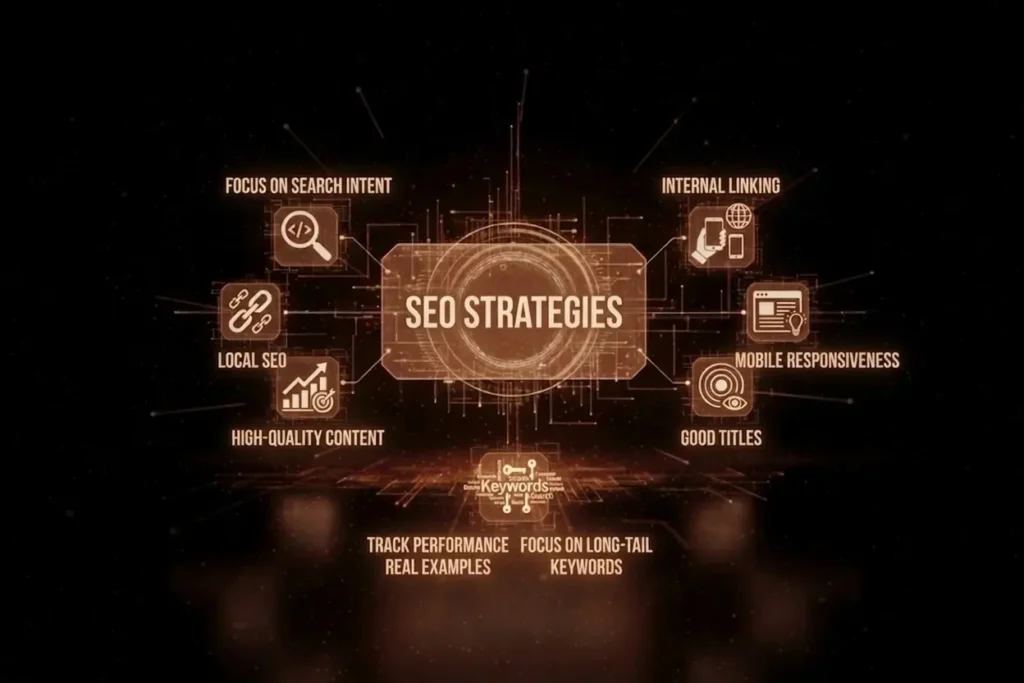
1. Stop Chasing Keywords, Focus on Search Intent
Most of the people, likely beginners, think SEO is just about keywords no, that’s an outdated thinking.
Google’s priority is search intent, what the user actually wants.
Mainly there are 3 types of Intent:
- Informational : Users intention will be to know certain information of a particular term Eg. “ What is SEO?”
- Commercial : Users search with the terms like best, reviews, price etc. for products/services that have a chance to buy in future. Eg. “best digital marketing agency in Kerala”
- Transactional : It’s when the users highly have a chance to buy like in present. It includes words like buy, purchase, order, hire etc Eg.”hire SEO expert near me”
There are 2 more which are Navigational and Local Intent:
In Navigational the user particularly adds which website/brand they want Eg. Youtube, Facebook, Hubspot etc. and in Local their intent will be a particular location. Eg. “Digital Marketing Specialist in Palakkad“
So understand the search intent of users and match the content with the intent.
2. Use Local SEO to Your Advantage
This is what we discussed in search intent briefly, to rank on local queries of users you have to do Local SEO. You don’t need to rank globally. You need to rank locally.
In this case what you have to do is :
- Add location-based keywords naturally
- Create and optimize your Google Business Profile
- Mention your location in headings and content
For example :
Instead of using simply “ SEO services” use “ SEO services in Kerala” or “ SEO services in Palakkad”.
These will have low competition and have high chances of ranking and you can get relevant traffic to your website too.
3. Create Consistent, High-Quality Content
This tells about publishing quality content in your website like uploading one blog in your website can’t get you results. Even three won’t.
SEO works when you build topical authority, which says a website’s credibility and expertise on a particular subject. Websites with strong topical authority are considered trustable resources by the search engines.
To increase topical authority of your website you have to:
- Publish 2-3 blogs per week
- Cover related topics (pillar-cluster strategy)
- Writing important in-depth useful content to users
Always make your topics stand out more by making them specific.
For eg. Instead of writing simply “Marketing Tips” make sure to make the topic/title specific by making it like“SEO for small businesses in 2026” or “Email marketing for small businesses”. Because specific topics rank better.
4. Build Strong Internal Linking
Most people, especially beginners ignore this, this really kills SEO growth. Internal links are links which connect two pages of the same website, like we can give links from our home page to the service page. Internal Linking helps Google understand which page is important and how the content is connected.
What to do:
- Link every blog to your main page
- Link blogs to your pillar content
- Connect related blogs together
This can build authority and improve the ranking of your page.
5. Optimize Your Website for Speed and Mobile
If you have great content on your website but your website has loading issues or your website is slow, you won’t rank. Another important thing Google prioritizes is user experience.
To know about this you should check your:
- Page load time (under 3 seconds)
- Mobile responsiveness
- Image optimization
If your website has heavy images, animations, or poorly coded themes can slow your site and increase bounce rate. Make sure that your site is faster so it can help to rank better and give users a better experience.
6. Write Titles That People Actually Click
Like search intent, titles are also important. Your content may be good but your title is weak. Nobody will click your site. Titles play a major role in gaining clicks. You have to make sure that your title is strong enough to make people click.
For Eg. If you optimize your title like “SEO Guide for Beginners” it’s weak, instead if your title is “7 SEO Strategies Small Businesses Must Use in 2026” like this it is strong and it clearly says what’s inside the blog and what the users are going to read. Your title impacts your CTR and ranking.
7. Track Performance and Improve Continuously
We can’t upload content and simply forget it. SEO is not “write and forget”. You always need to keep tracking your website performance and analyze what’s wrong and what’s working. It helps for the content you are going to write in future.
You can use Google Search Console to check:
- Which keywords you are ranking for
- Which pages get impressions
- Your click-through rate
- In which country your showing more
- Total clicks, impressions, average position etc.
Example:
If a blog is getting impressions but no clicks:
- Your title or meta description is weak
If it gets clicks but no ranking:
- Your content is not strong enough
8. Add Real Examples and Practical Insights
This is where most blogs tend to fail because most of them keep it generic. If you want Google to prefer your website Google must feel your content is real and useful. And when people read with real examples they can understand a concept more than just mere definitions.
Example:
Instead of saying:
“Make your title attractive”
Say :
Make your title attractive like “SEO for small businesses in 2026” this.
Even if it’s a simple example, it makes your content stronger and more relatable.
9. Focus on Long-Tail Keywords First
If you are doing SEO for the first time, trying to rank for broad keywords is a mistake. You won’t beat established websites immediately. Start with long tail keywords such as:
- “SEO for small businesses in Kerala”
- “digital marketing for local businesses”
- “how to rank small business website on Google”
Because these keywords will have lower competition and higher conversion potential. Win small first, then scale.
Conclusion
From this we can understand that SEO is not about tricks, hacks, or shortcuts.
It’s about :
- Understanding what people are searching for
- Creating content that solves real problems
- Staying consistent over time
Small businesses that start focusing on SEO now will build a long-term advantage over competitors who rely only on ads or social media.
If you follow these strategies and stay consistent, your website can become a reliable source of traffic, leads, and growth.